
One of the classic D&D tropes is that a gang of humanoids often includes “a leader type.” In old editions, this humanoid foreman gets a one-line description as “fights as [humanoid one increment higher by hit dice]” and in 5e they get their own page in Leomund’s Condominium of Antagonists. Back on Earth, it is true that basically all cultures have some level of hierarchy, with some people, almost always male, having more power and influence than others.* However the details of what human leader types look like varies a lot and anthropologists distinguish between various leader types in ways that can be subtle, but imply very different social structures.
One of the classic articulations of the distinction is in Sahlins’s article “Poor Man, Rich Man, Big-Man, Chief: Political Types in Melanesia and Polynesia.” In both Polynesia (e.g., Hawaii and Tahiti) and Melanesia (e.g., New Guinea and Fiji), there are traditionally men with particularly great influence in a community, but the nature of influence varies. Polynesians have chiefs or kings in a way that is very familiar cross-culturally. The status is not earned but one of noble blood that marks out the nobility as distinctive but vulnerable to pollution. Melanesians have “big men,” a status that is achieved through giving and receiving gifts. As such, gift exchange scholars are obsessed with big men and their associated practices of potlatch (competitive feasting).
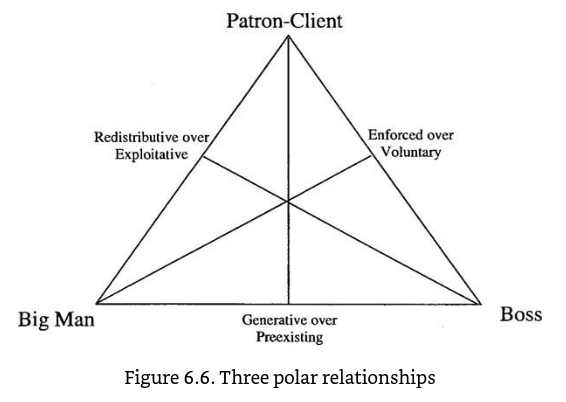
In his book Social Structures, John Levi Martin draws on Sahlins, and renames the chief a “patron,” but further adds the political “boss” or cacique type to create a schema with three dimensions and three ideal-types. The political boss is fundamentally a broker between a community and the resources of the state, especially in a one-party state or at least a one-party region. Examples of the boss type include Chicago aldermen, George Parr (who sold Duval county to LBJ in the 1948 Texas senate Democratic primary), and local PRI party organizers in Mexico (especially from 1929-2000). Even though the party boss is not a nobleman, the locals have no choice but to work with him.
So how do you game this?
One way is to look at JLM’s diagram and plot different cultures or fantasy races in different points in the triangle and then spin out the world-building from there. But let’s get more concrete about how to apply the ideal-types.
The chief is trivial as that’s the default assumption in fantasy literature and fantasy gaming. However you can borrow from anthropology a lot of color about how different cultures treat their chiefs and, again, Polynesians are a great example.
The big man is distinctive from the other two types in that the big man assumes no overall political structure, or at least is orthogonal to the overall political structure. It is a position of esteem more than power and involves multiple competing big men who express their rivalry through gifts and potlatch. So you could have a big orc competing with another big orc over who can provide the most gnome meat for the feast of the blood solstice. This lends itself to adventure hooks like the monsters raiding ye olde village for loot/livestock/prisoners to distribute as gifts or the adventurers engaging in faction play of one big man vs another within the same community.
The party boss lends itself naturally to understanding the local miniboss in an evil territory, especially if the structure is semi-democratic so the ultimate leader strongly depends on being able to mobilize endorsements from below. So the gnoll steppe khanate may have an elective monarch who allocates raiding territories to local gnollarchs, but who himself owes his power to the gnollarchs when they assemble as delegates at the kurultai. Or perhaps the Empire of Evil Wizards is governed by an assembly of satraps who themselves require periodic acclimation by each village, with that acclamation being coerced by the village boss. The implications for faction play spin out when you take the example that one of the causes of the escalating drug war in Mexico is that the rise of multi-party democracy in the last generation has unsettled long-standing accommodations between PRI bosses and narcotrafficantes.**
This post was written in part for the “Anthropology and Archaeology” blog carnival hosted by Beneath Foreign Planets.
* The idea of primitive matriarchies is more or less a myth. See Hutton’s Queens of the Wild for the case of pre-Indo-European cultures in Europe (people whom geneticists call “Early European Farmers”). Societies with matrilineal kinship are common, but that is a distinct question from matriarchy like you see on Wonder Woman’ style matriarchy’s island. For instance, the Navajo are traditionally a matrilineal (descent goes through the mother) and matrilocal (grooms move, brides stay) culture, but it would be a gross exaggeration to call them a matriarchy as traditionally Navajo men held most political power.
** Villareal uses the term “patron” but in JLM’s schema these local power brokers are “bosses.”
 homicidallyinclinedpersonsofnofixedaddress.com
Leave a comment