-
Chesterton’s d20
AD&D as Crunchy OD&D Case Law
If you read Peterson’s Game Wizards you see one of Arneson’s many failed projects was an index for D&D. This was necessary because within a few years finding rules spread across the white box and the three supplements was difficult and confusing. Unfortunately for Arneson, the publication of Advanced Dungeons & Dragons rendered the effort both superfluous and obsolete as soon it was published. A big part of what AD&D did was take all the stuff Arneson indexed and put it in a coherently organized fashion. Well, coherently organized relative to original D&D and its supplements if not relative to such later revisions of AD&D as AD&D 2e, OSRIC, or Hyperborea. Of course, AD&D was more than reorganization but also included a lot of fiddly bits, which is why Swords & Wizardry: Complete (retroclone of OD&D + supplements) and OSRIC (retroclone of AD&D) are similar but different games.
(more…) -
Corinthian constrictor
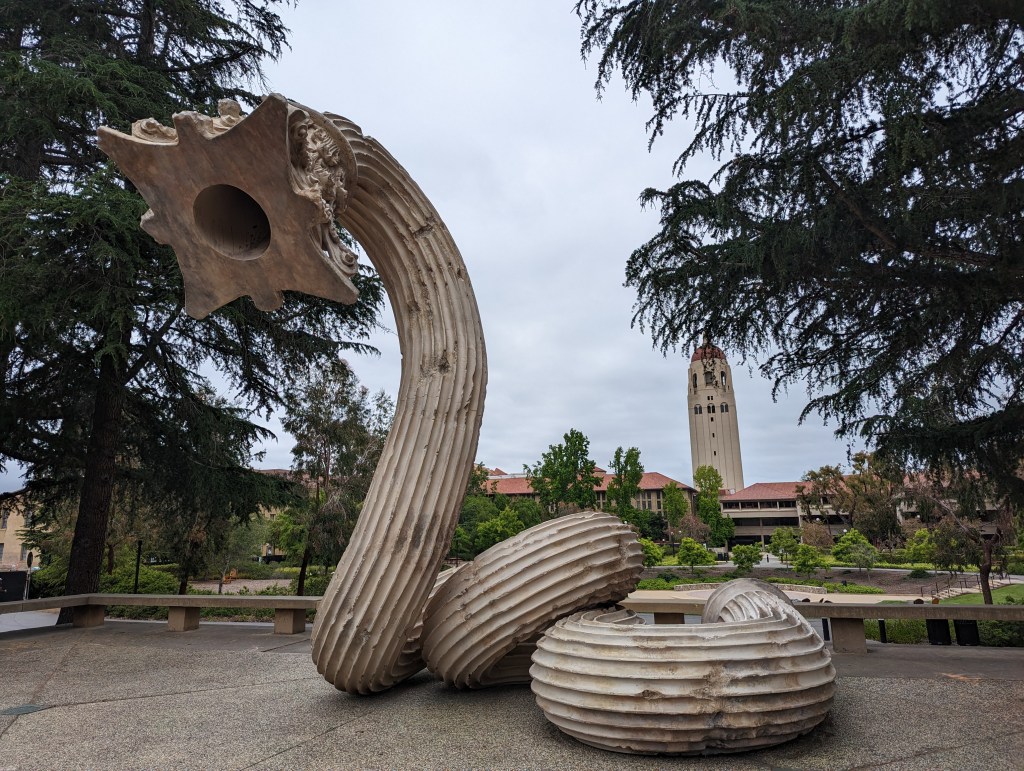
20′ long construct typically used to guard tombs or temples. Attacks only when trigger condition is met (e.g., someone tries to take the treasure, someone passes a certain point). At rest it is either a toppled column or a standing one in an architecturally appropriate place.
Armor Class 4 [15] Hit Dice 14* (63hp) Attacks 1 × head bash (3d8 + constriction) THAC0 9 [+10] Movement 60’ (20’) Saving Throws D8 W9 P10 B10 S12 (7) Morale 12 Alignment Neutral XP 2300 Number Appearing 1d2 Treasure Type None
- Mundane damage immunity: Can only be harmed by magical attacks.
- Immunity: Unharmed by gas; unaffected by charm, hold, and sleep spells.
- Energy immunity: Unharmed by fire, cold, and electricity.
- Hypnotize: As alternative to attack, may sway rhythmically to render immobile and unable to speak or act up to 20 HD of creatures. Subjects get saving throw vs spell. Subjects who fail a saving throw recover two rounds after the swaying ceases.
- Constriction: When a head bash attack is successful, the python wraps around the victim and begins to squeeze, inflicting 2d8 automatic damage immediately and on each subsequent round. Only one victim may be constricted at a time, though may head bash others.
- Camouflage: Difficult to detect if encountered in an area with the appropriate architecture.
Inspired by Xu Zhen’s sculpture “Hello.” Author’s photo, I’m OK with you using my photo of it but no idea if Xu or Stanford University have rights to my photo of their sculpture.
-
More Gygax’s Finches
In a previous Gygaxian naturalism post I gave some thoughts on D&D implications of allopatric speciation. This is what people usually have in mind with evolution, where two populations are physically separated and so diverge genetically, especially if the two environments differ. For instance, a storm blows finches from the mainland to an island which both has a different climate than the mainland and presents a barrier to gene flow.
A more unusual form of evolution is sympatric speciation and its companion of disruptive selection. Sympatric speciation occurs when there is divergence despite no geographic barrier to gene flow. Disruptive selection is when selection promotes extreme forms and weeds out intermediate forms. The two are connected since disruptive selection is one way sympatric speciation can work.
As with last time, let us consider the orc, but this time by contrasting them to goblins. Orcs and goblins are both nocturnal humanoids. They both live in dungeons. And WotC era D&D lore notwithstanding, we can assume they have a common ancestor. If orcs and goblins were to develop into different species via allopatric speciation, they’d have to be geographically separated but that doesn’t fit with them having the same geographical range (i.e., they appear on the same random encounter tables). So we need a sympatric speciation explanation and that means disruptive selection.
For disruptive selection to work, we need to see less survival and/or reproductive success for intermediate forms. So really this means big orcs and small goblins should survive and have lots of babies but medium goblin-orcs should die young and/or be last asked for a dance at the dungeon winter formal. Let’s suppose that for the goblin and orc population that fitness basically reduces down to martial prowess. The more dwarf and elf skulls males collect, the younger they marry and more extramarital pairings they attract. So why would you be a badass as a 4′ tall goblin or a 6′ tall orc but not as a 5′ tall intermediate form?
(more…) -
Right-skewed dice
As I’m guessing was true for many of you, my first introduction to probability theory was pages 9-10 of the AD&D DMG in which Gygax explains how rolling one die (including d100) gives you a uniform distribution but summing multiple dice gives you a bell curve. Ever since, it has been a basic principal of game design to distinguish between when a uniform distribution is desirable (e.g., action resolution) and when a bell curve is better (e.g., character abilities). Appreciation of uniform distributions (each value is equally likely) vs bell curves (moderate values are most likely) is all well and good but in probability and statistics there is a third major type of distribution that RPGS usually ignore: right-skewed distributions (low values are most likely). Note that in statistics “skew” means the direction the “tail” of the distribution is pointing. So on a right-skewed distribution, most cases are low (left) and it’s rare to have cases that are high (right).
There are a lot of things in life and even in fantasy worlds where low numbers are the most common values. The typical scroll should be low level, the typical orc war party should be small, etc. Alas, we generally don’t model this. I had this thought while reading Shadowdark and seeing the rules for generating rival adventuring parties. When it comes to level, you simply roll d6. I thought, huh, that’s weird, shouldn’t 1st and 2nd level parties be more common than 5th and 6th level parties?
I thought about it all day and came up with some pretty complicated mechanics and then realized there’s an incredibly simple approach.
Choose a die size that captures the range you want. Roll multiple dice and keep the lowest. The more dice you roll, the more right skewed the probability distribution will be.
(more…) -
Shadowdark review
As a Kickstarter backer for Shadowdark I have read the PDF and my bottom line is it’s a really great game that skillfully synthesizes many different ideas and mechanics. If you were turned off by the hype, don’t be. I see it as a really well executed effort for what it intends to accomplish. I suggest you consider if you’re in the market for that type of game, and if so check out the free quickstart guide. My own feeling is that in some ways it is what I’d been waiting for, but explaining why requires a digression.
(more…) -
Gygax’s Finches
The dungeon is a strange environment. And I don’t mean that just in the mythic underworld sense, but in the sense of Gygaxian naturalism. One of the basic issues is where do the monsters come from? For undead and demons and such the answer is basically “magic,” which settles the issue. Often these undead or demons or elementals or constructs were “stocked” by a necromancer or summoner who may or may not himself remain in the dungeon as the final boss lich. Similarly, we can imagine a mad wizard sending some lackeys to pick up an order for roper spores, stirge eggs, and a gelatinous cube starter culture at ye olde home and garden center. Of course the entire conceit of a mad wizard funhouse dungeon is don’t ask how it works, did I mention the wizard was insane, Bob’s your uncle. Let’s put such deliberately stocked dungeons aside and engage in the Gygaxian naturalism of thinking through how monsters might naturally occupy the ecological niche of the dungeon in the same way as we explain how the common raven came to occupy most of the northern hemisphere or the California mussel cling to every other salt-sprayed boulder from Alaska to Baja.
First, let us consider the simple case of monsters that are found in both dungeons and the wilderness. For instance, the orc is found on low-level dungeon tables and almost every wilderness random encounter table in OSE, Swords & Wizardry, and OSRIC. For a monster like orcs, it’s easy to explain how they got to a particular dungeon: they occupy lots of ecological niches and so even if two dungeons are separated by forest, or hills, or mountains, or first forest, then hills, then mountains; no problem, orcs inhabit all those places. Orcs are what biologists call generalists and it’s pretty easy to explain how generalists spread from place to place which is why some generalists (e.g., the common raven, the brown rat, people) have an enormous range. Generalist monsters like orcs that are found frequently above and below the surface might even form a single breeding population, but maybe not.
For instance, the orcs of the Misty Mountains at some point migrated from Mordor, crossing Rohan on the way. Or maybe vice versa, I don’t care enough about the canonical answer to read Encyclopedia of Arda, let alone the RotK appendices and the Silmarillion. The point is you can imagine orcs in Middle Earth having spread much the same way as human beings here on Earth. Human beings and zebras both evolved in an African grassland environment but we eventually reached the grasslands of South America and the zebras didn’t because we could also occupy the many diverse ecosystems between Kenya and Argentina. Once orcs are spread out enough over a wide enough range, you might get linguistic / ethnic / cultural differences among orcs in different areas, just as human beings show a lot of diversity, but how the orcs got there is not tricky.
The much harder problem is what about monsters that only live in the dungeon. The carrion crawler, gelatinous cube, rust monster, purple worm, cloaker, cave fisher, drow, duergar, and svirfneblin are all what biologists call specialists. One thing about specialists in real life is they tend to have limited range because even if there is another cozy dungeon a hundred miles away, you can’t get here from there. So a cave fisher in Temple of Elemental Evil might do very well by its offspring to lay its eggs in The Lost Caverns of Tsojcanth, but it is so hyper-evolved to live in a dungeon that it has no way to leave a dungeon in the Yatil Mountains, cross a few hundred miles of farms and forest, and settle in to another dungeon on the far side of Veluna.
(more…) -
OGL 1.2 reactions
The following is my entry for the main free entry text block at the beginning of the OGL 1.2 “playtest” survey. As such, the second person “you” is WotC. Note that one function of the “playtest” is to kill the momentum of backlash to WotC. If we all publicly post our feedback, that will keep the issue salient, which it needs to remain since I am highly skeptical they’ll get the survey results and say “the people have spoken, we are reissuing the OGL 1.0a and adding the word ‘irrevocable.”
(more…) -
OGL trouble
Like all of us, I’ve been paying close attention to the OGL revisions. I am not a lawyer, intellectual property or otherwise, but I have studied media industries, and so have some thoughts on all this. I see three basic questions:
- What rights could you defend in court?
- How likely are you to have to defend those rights?
- How will the community and industry respond?
Let’s take them in turn.
(more…) -
Rifts Atlantis for D&D and OSR
Rifts is a post-apocalyptic giant robots firing missiles at demons game, which isn’t exactly the kind of thing you think of for OSR or D&D, but Rifts: Atlantis is readily adaptable to the OSR. Atlantis has relatively little of the fascists and giant robots world-building that characterizes most of Rifts but rather is sword and planet with a hint of Lovecraft. That sort of thing seems anomalous from the high fantasy perspective that dominates D&D now, but it characterized a lot of the Appendix N literature and was a strong theme in old school D&D and OSR, from “Expedition to Barrier Peaks” to Hyperborea. The Rifts rules are pretty different from D&D so Atlantis is not exactly ready to run out of the box as OSR, but it has great potential as adaptation material for a major faction in your campaign world. I’ll first give a synopsis and then some ideas on adaptation.
The basic premise of Rifts: Atlantis is that an interdimensional alien confederation has established a territorial base for slave raids where they capture people and then sell them off in other dimensions, often after altering them with magical tattoos or magical parasites. The alien confederation are led by truly inhuman Lovecraft type entities, then about a dozen types of more or less humanoid aliens, and finally actual people at the bottom of the org chart. Much as real world empires are usually named for the numerically small nation at the top rather than the more numerous but diverse peoples they rule, the aliens are called the Slugorth even though only the handful of Lovecraft entities are actually Slugorth in the limited sense.
(more…)


